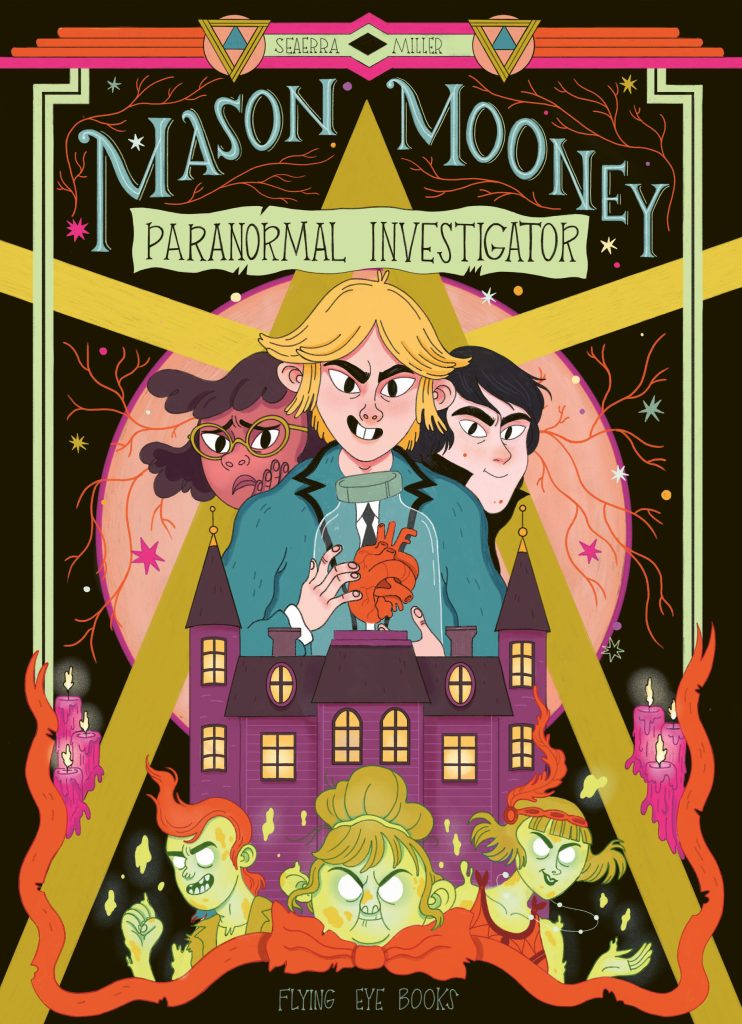
I stumbled across this children’s graphic novel quite by chance, when I saw someone posting on Instagram about its forthcoming sequel. Searching for further details about that, I immediately spotted this heart in a jar on the cover of book one. Obviously I had to get hold of a copy!
Mason Mooney, the blond-haired boy in the centre of the cover image, is a paranormal investigator who claims to be the best in the business, definitely much better than his popular rivals, The Paranormal Society – a group of teens who mostly investigate cases that occur where the lighting is most flattering for TV.
You could say that Mason is something of a mystery himself. After all it’s not every day you meet someone who carries around a live, beating heart in a jar. He’s a bit stingy with the details on how that came to be. All I know is that it has something to do with a Death Worm and some legal technicalities.
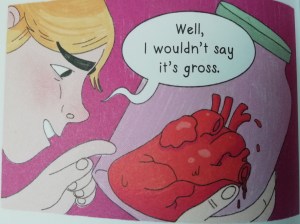
Mason Mooney: Paranormal Investigator by Seaerra Miller, p.4
As the book progresses, readers do discover a little more about Mason and the mysterious heart in the jar…

If you’d like to discover Mason’s backstory for yourself, stop reading now!
In the remainder of the book, we see Mason and his new maybe-friend/maybe-sidekick Iris solve a spooky situation AND we discover the backstory of the heart in the jar, as it’s revealed that Mason (in a bid to be the best paranormal investigator) once struck a deal with a witch, asking her to stop him feeling fear.
All I had to do was sign a very simple contract. So that’s what I did. My heart began to flutter then wham, bam, apple jam – all my fears disappeared! Admittedly, I had no idea that she was going to remove my ticker for good, but she explained it all in detail afterward. Not that it mattered anyway, I’d got my wish. Now I’m not afraid of anything.
Mason Mooney: Paranormal Investigator by Seaerra Miller, p.42
It’s not entirely clear what Mason’s personality was like before his heart was removed, but fear is certainly not the only sensitivity he seems to be lacking post-removal. Iris, when she discovers the truth about Mason’s heart, asks the same question as (I presume) most of the book’s readers: “Is this why you are such a grumpy-know-it-all-selfish-brag-pants who’s more concerned with fame and glory than helping others?”

As you can see from this intriguing spread, it looks as though Mason and the disembodied heart are able to communicate (Mason verbally and the heart by thumping) and Mason admits that his heart still tries to boss him around, but claims it’s much easier to ignore the heart now that it’s inside a jar rather than inside his chest.

As the application of the unicorn cushion demonstrates, Mason’s attempts to “ignore” his heart are fairly literal and, perhaps, not all that successful? Mason is depicted as taking his heart everywhere he goes and, surely, if the disembodied organ is always close by, Mason can only ignore what his heart is trying to tell him up to a point? The actions of Mason’s heart still suggest or guide him towards certain feelings in certain situations. Being bodily separate from but in communicable distance with his heart, surely means that Mason always knows what he would (or should?) be feeling if his heart had remained in his chest.
This being aware of a feeling without feeling that feeling reminds me of the poem ‘Pacemaker’ by W.D. Snodgrass.
I thought I’d always favor rubato
Or syncopation, scorning fixed rhythms;
Thought my old heartthrobs could stand up to stress;
Believed one’s bloodpump should skip a few beats
If it fell into company with sleek young women
Believed my own bruit could beat with the best.
Wrong again, Snodgrass!
From ‘Pacemaker’ by W.D. Snodgrass.
When we link our heart’s freedom to move at its own pace – maybe even to behave in unusual or undesirable ways – with the way we feel certain emotions, what does it mean when a “new gold gadget” like Snodgrass’s pacemaker imposes a pace and rhythm of its own? If we, like Mason Mooney, can’t feel the physiological aspect of our responses, are we really feeling that emotional response at all? Of course I, as a pacemaker recipient, do feel emotions. Do I feel them to the same extent? I think so…but maybe I’m not 100% sure. And even if I was sure, how and why are authors using adapted or absent hearts in their characters, and what can these artistic interpretations tell us about real-life opinions and (mis)conceptions of medically altered hearts?
These types of questions are what I’m busy pondering at the moment, mostly by examining Cogheart (Peter Bunzl) and The Tin Woodman of Oz (L. Frank Baum). I’m really happy to have discovered, so randomly, the characters of Mason Mooney and his heart to add to that discussion.
The second book about Mason Mooney is due out later this year and I’m so looking forward to reading it. I’m excited to learn more about the relationship between Mason and his heart – how exactly he and his heart communicate; whether the heart can communicate with anyone else; whether Mason will (as Iris suggests he should) attempt to find a way out of his contract with the witch in order to get his heart back in his body, and how that will affect his personality if he does.
P.S. If you are interested in reading more about the history of the heart’s link to emotions, I would recommend Fay Bound Alberti’s book Matters of the Heart: History, Medicine and Emotion.
 hearty tales
[…] in an attempt to make them invulnerable) is a recurring theme in stories for children. Remember my post about Mason Mooney a few weeks […]
LikeLike