
Content warning: images (pixelated) of autopsy and discussion of murder, in the context of BBC drama Silent Witness.

“She’s got a pacemaker. Do we know if Joanna Garrick had a heart condition? So pacemakers store data about heart rate and stress patterns, like a mini computer. So if this had enough memory, it should show all event information, up to the point of death. Even a time and date.”
I don’t generally watch Silent Witness (although in a previous incarnation I used to LOVE writing the subtitles for it) but last week a friend tipped me off to a recent storyline featuring a pacemaker. Did you see it? I got very excited when I saw the scene pictured above, thinking the pacemaker was going to be central to solving the crime and catching the killer and, in a sense, it was. They used the device to identify the deceased person it was found in (don’t worry, no spoilers here) and it gave some clues as to motive, but there was no real digging into the data to discover more about the person’s last moments of life. I liked the inclusion of the pacemaker in the storyline but I wanted MORE!
I often think there’s a great old-school crime story just waiting to be written that uses a cardiac device in some super clever way and this episode of Silent Witness has made me more convinced of that than ever. If anyone reading this fancies giving a pacemaker-based crime story a go, I will be forever grateful! There are some real-life “crime dramas” that could offer further inspiration…
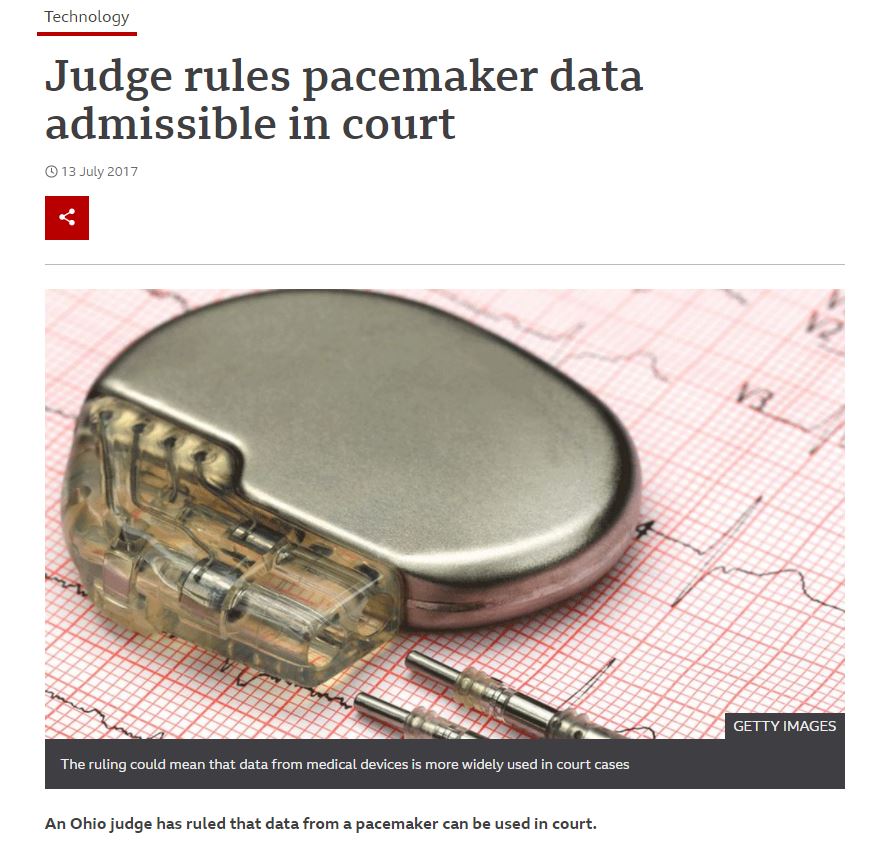
In the USA, pacemaker data has been used as evidence in a real-life criminal trial, leading to the 2017 conviction of Ross Compton in Ohio. Compton’s claims that his house caught fire while he was sleeping, leaving just enough time for him to grab a few belongings and exit via a window, was deemed to be false – a judgment based partially on information retrieved from the defendant’s pacemaker, contradicting his claim that he was asleep when the fire started. Compton’s legal team challenged the court’s decision to use data from the defendant’s medical device, claiming it violated Compton’s right to privacy, but the judge ruled that the evidence was admissible because the procedure to retrieve it was not excessively intrusive or invasive, posing no medical risk or adverse impact on the human dignity of the defender. Any of us with a cardiac device will be very familiar with the placing of “the wand” (usually outside our clothes) to garner data from our devices at regular checks, and this was exactly the procedure used to collect the evidence that led to Compton’s imprisonment. The judge, as well as finding the search and seizure was reasonable, concluded that the collection of heartbeat data and its use as evidence in a court of law was “just not that big of a deal” (State of Ohio v Ross Compton, Case No. CR 2016-12-1826). Yes, gasp! Since this ruling, data from pacemakers has been used in the state of Ohio in at least two murder cases.
I’m not sure what the law in the UK would have to say about all this? We hear more and more often of information from smart devices (fitness watches, voice-activated speakers, smartphones, etc.) being used as evidence, but it seems to me that there’s something very different about the information stored on a device used for medical reasons. A person can make an informed choice about whether they want to have a smart watch and can choose whether or not to wear it on any given day. But the choice is not so freely made when it comes to devices that are implanted, permanent, and have the intended outcome of keeping a person alive. Unless the law protects the privacy of pacemaker recipients, there’s every chance the devices keeping us alive could be used against us. What use is our right to silence when our pacemakers won’t ever stop talking?
Do you have a cardiac device? Have you ever thought about your rights when it comes to data and privacy? What a can of worms!
References: Maras, Marie-Helen, and Adam Scott Wandt. “State of Ohio v. Ross Compton: Internet-Enabled Medical Device Data Introduced as Evidence of Arson and Insurance Fraud.” The International Journal of Evidence & Proof 24, no. 3 (July 2020): 321–28. https://doi.org/10.1177/1365712720930600.
 hearty tales
I do sometimes wonder what they can see, like that 2nd cup of coffee that you shouldn’t of had 😉
LikeLiked by 1 person
Ha, yes! I can never resist the second cup with breakfast. Very naughty…
I had my device check just the other day and wanted to ask so much about what the technician was doing and discovering about me…but I just spoke about COVID and the weather instead! 😂
LikeLike